
2023/6/10大约 7 分钟
1. 线程同步
1.1线程安全问题:
- 同步和异步:CPU的切换
- 临界区
- 阻塞和非阻塞:限制访问临界区权限
线程安全:
- 多个线程同时操作同一个临界区共享资源的时候,可能会出现的业务安全问题
- 银行取钱
package 线程下;

public class Demo1 {
    public static void main(String[] args) {
        Manger manger=new Manger();
        Thread t1=new Thread(manger);
        Thread t2=new Thread(manger);
        t1.start();
        t2.start();
    }
}
class Manger implements Runnable{
    Account account=new Account();

    @Override
    public void run() {
        CheckBlance(60000);

    }
    public  void CheckBlance(int money){
        if (account.getBalance()>money){//出现线程安全问题
            System.out.println("余额充足");
            account.setBalance(account.getBalance()-money);
            System.out.println("余额剩余:"+account.getBalance());
        }else {
            System.out.println("余额不足:"+account.getBalance());
        }

    }
}
class Account{
    private String id;
    private float balance=100000;

    public String getId() {
        return id;
    }

    public void setId(String id) {
        this.id = id;
    }

    public float getBalance() {
        return balance;
    }

    public void setBalance(float balance) {
        this.balance = balance;
    }

    @Override
    public String toString() {
        return "Account{" +
                "id='" + id + '\'' +
                ", balance=" + balance +
                '}';
    }
}
- 银行取钱
1.2 线程同步的实现
同步方法:
//在方法上加上synchronized关键字
package 线程下;

public class Demo1 {
    public static void main(String[] args) {
        Manger manger=new Manger();
        Thread t1=new Thread(manger);
        Thread t2=new Thread(manger);
        t1.start();
        t2.start();
    }
}
class Manger implements Runnable{
    Account account=new Account();

    @Override
    public void run() {
        CheckBlance(60000);

    }
    public  synchronized void CheckBlance(int money){
        if (account.getBalance()>money){
            System.out.println("余额充足");
            account.setBalance(account.getBalance()-money);
            System.out.println("余额剩余:"+account.getBalance());
        }else {
            System.out.println("余额不足:"+account.getBalance());
        }

    }
}
class Account{
    private String id;
    private float balance=100000;

    public String getId() {
        return id;
    }

    public void setId(String id) {
        this.id = id;
    }

    public float getBalance() {
        return balance;
    }

    public void setBalance(float balance) {
        this.balance = balance;
    }

    @Override
    public String toString() {
        return "Account{" +
                "id='" + id + '\'' +
                ", balance=" + balance +
                '}';
    }
}
同步块:
public class Test {
    public static void main(String[] args) {
        synchronized (Test.class) {//同步代码块
            int  a = 1;
        }
    }
}

public class Test{
    private String name = "xiaoming";
    private String id = "0753";
    public void setName(String name) {
        synchornized(name) {//同步代码块
            this.name = name;
        }
    }
    public void setId(String id) {
        synchornized(id) {
            this.id = id;
        }
    }
}
小结:
- 同步:通过加锁让出现线程安全问题的核心代码能够实现同步,推荐使用同步块,锁定范围更加精准
1.3 锁的概念:
- 要实现同步就需要锁,一把钥匙对应一把锁,当我们实现同步的时候就只能是一把钥匙和一把锁
锁的分类:
- 类锁:类的Class对象
- 对象锁:基于当前对象this
- 私有锁:我们创建的某个对象
以上三种锁本质上都是对象锁
对个线程之间使用同一个锁,使用同一个对象锁
类锁:
public synchronized static void test{
        System.out.println("这是第一种类锁");
    }
    public static void test2(){
        synchronized (Demo2.class){
            System.out.println("这是第二种类锁");
        }
    }
对象锁:
   public synchronized void test3(){
        System.out.println("这是对象锁");//谁调用这个方法的对象谁就使用这个锁
    }
    public void test4(){
        synchronized (this){
            System.out.println("这是对象锁");
        }
    }
私有锁:
   String lock=new String();
    public void test5(){
        synchronized (lock){
            System.out.println("这是私有锁");
        }
    }
1.4 同步案例:
sleep()
- 让出CPU
- 不让出锁
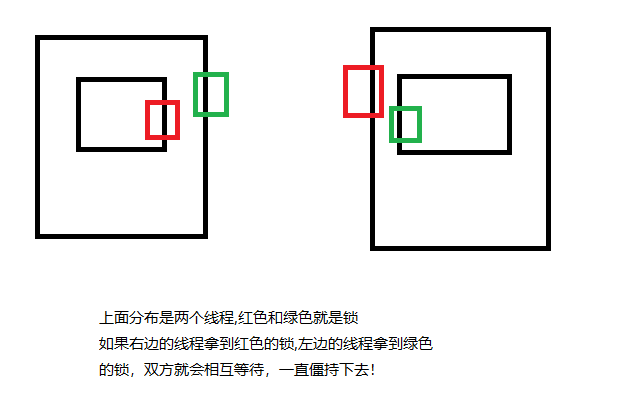
1.5 死锁
原理图:
1.6同步锁Lock
- JDK5之后
- Lock是一个接口,由ReentrantLock构建锁对象 synchronized和Lock的区别:
- Lock是一个接口,syn是一个关键字
- Lock通过方法调用,很清晰的实现了加锁和释放锁,syn自动,核心代码执行完后,自动释放锁
- Lock可以让等待锁的线程响应中断,syn不行,等待的线程要一直等待下去
- Lock的性能高于syn
2.线程通信
2.1什么是线程通信:
- 线程与线程之间相互独立,但是可以实现资源共享
- 线程通信互相发送数据
- 实现线程通信的方法来自Object
- 通过共享数据的方式实现线程间的通信
| 方法 | 方法说明 |
|---|---|
| void wait() | 当前线程等待并释放所占有的锁,直到另一个线程用notify()或者notifyAll()方法 |
| void notify() | 唤醒当前正在等待的单个线程 |
| void notifyAll() | 唤醒当前正在等待的所有线程 |
- notifyAll其实和notify一样,也是用于唤醒,但是前者是唤醒所有调用
wait()后处于等待的线程,而后者是看运气随机选择一个
2.2 生产者消费者模式:
- 也就是给出生产者和消费者(来自操作系统里面的概念),然后一个生产一个消费,或多个生产多个消费
package 线程下;

public class Demo5 {
    public static void main(String[] args) {
   Pool pool=new Pool();
        Producer producer = new Producer(pool);
        Consumer consumer = new Consumer(pool);
        Consumer consumer1=new Consumer(pool);
        producer.start();
        consumer.start();
        consumer1.start();

    }
}
//面包
class Bread {
    private int num;
}
//共享资源池
class Pool{
   int index=0;
    public synchronized void push(){

        while (this.index>20){
            try {
                this.wait();
            } catch (InterruptedException e) {
                throw new RuntimeException(e);
            }
        }
        this.index++;
        this.notifyAll();
    }
    public synchronized  void pop(){

        while (this.index==0){
            try {
                this.wait();
            } catch (InterruptedException e) {
                throw new RuntimeException(e);
            }
        }
        index--;
        notify();
    }

}
class Producer extends Thread{
    Pool pool;
    public Producer(Pool pool){
        this.pool=pool;
    }
    @Override
    public void run() {

        while (true){

            pool.push();
            System.out.println(Thread.currentThread().getName()+"生产者:"+pool.index);

        }
    }

}
class Consumer extends Thread{
    Pool pool;
    public Consumer(Pool pool){
        this.pool=pool;
    }

    @Override
    public void run() {
        while (true){
        pool.pop();
            System.out.println(Thread.currentThread().getName()+"消费者:"+pool.index);

        }
    }
}
3. 线程池:
3.1线程池概念:
- 可复用的线程技术
- 程序中有可能涉及大量生存期很短的线程
- 多次重复过程:创建新的线程对象,对象销毁
- 使用线程池:
- 存储多个线程对象的资源池
- 当需要新的线程对象时,从线程池中去取,将线程对象放回资源池
- 提高启动多个线程的性能
3.2 JDK内置线程池:
JDK5开始提供
线程池分类:
- SingleThreadPool:单线程化线程池,资源池中只有唯一的一个工作线程来执行任务,任务按照指定顺序执行(FIFO,优先级别)
- FixedThreadPool:一个可重用的固定数量的线程池
- CachedThreadPool:一个可重用的数量可变的线程池,可根据需要创建新线程
- ScheduledThreadPool:一个固定数量的线程池,支持定时及周期任务的调度
线程池API:
使用Executors实现线程池:
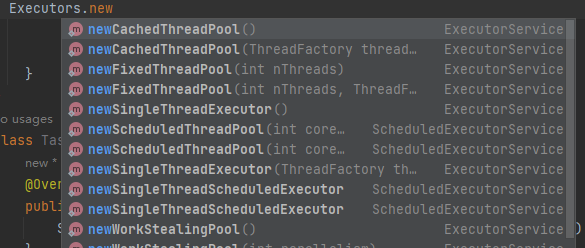
相当于一个工具类,底层也是基于ThreadPoolExecutor,在大型并发系统中不推荐使用Executors,系统风险
线程池的简单使用
package 线程下;

import java.util.concurrent.*;

public class Demo4 {
    public static void main(String[] args) {
        ScheduledThreadPoolExecutor pool = new ScheduledThreadPoolExecutor(3);
        Task t1 = new Task();
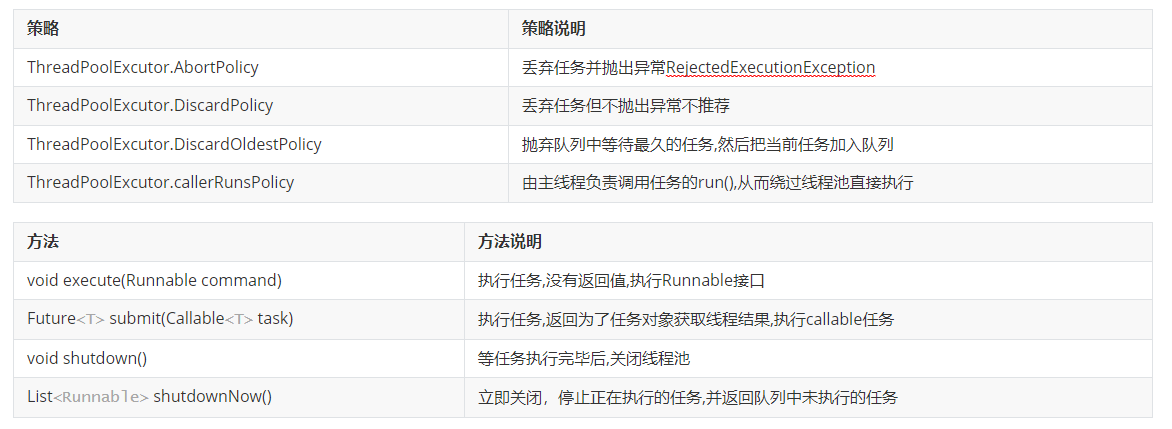
        ThreadPoolExecutor threadPoolExecutor = new ThreadPoolExecutor(3,6,5,TimeUnit.SECONDS,new ArrayBlockingQueue<>(3),
                Executors.defaultThreadFactory(),new ThreadPoolExecutor.AbortPolicy());
        threadPoolExecutor.execute(t1);
        threadPoolExecutor.execute(t1);
        threadPoolExecutor.execute(t1);

        threadPoolExecutor.execute(t1);
        threadPoolExecutor.execute(t1);
        threadPoolExecutor.execute(t1);
        threadPoolExecutor.execute(t1);
        threadPoolExecutor.execute(t1);

//        threadPoolExecutor.execute(t1);
//        threadPoolExecutor.execute(t1);
//        threadPoolExecutor.execute(t1);
//        threadPoolExecutor.execute(t1);
//        threadPoolExecutor.execute(t1);
//        threadPoolExecutor.execute(t1);

    }
}
class Task implements Runnable{
    @Override
    public void run() {
        System.out.println(Thread.currentThread().getName()+":线程任务执行");
    }
}
4. 线程调度
4.1调度线程池:
import java.util.concurrent.ScheduledExecutorService;
import java.util.concurrent.ScheduledThreadPoolExecutor;
import java.util.concurrent.TimeUnit;

public class Demo4 {
    public static void main(String[] args) {
        ScheduledThreadPoolExecutor pool = new ScheduledThreadPoolExecutor(3);
        Task t1 = new Task();

        pool.scheduleWithFixedDelay(t1,5,5, TimeUnit.SECONDS);

    }
}
class Task implements Runnable{
    @Override
    public void run() {
        System.out.println(Thread.currentThread().getName()+":线程任务执行");
    }
}
4.2 Timer和TimerTask
- Timer是定时器:定时执行任务
- TimerTask任务对象
他们是单线程任务调度
- 任务放入任务列表当中,Timer对象接收任务和时间的绑定
- TimerThread在Timer对象创建的时候成为一个守护线程
- TimerThread找到任务列表中最近要执行的任务,记录后休眠
- 到了任务执行时间,TimerThread执行任务
- 再次遍历列表,记录下一次执行的任务和时间
同一时间只有一个任务被调度,上一个执行的会影响下一个执行的时间
import java.util.Timer;
import java.util.TimerTask;

public class Demo3 {
    public static void main(String[] args) throws InterruptedException {
        long delay=1000;
        long period=1000;
        MyTimerTask myTimerTask = new MyTimerTask();
        Timer timer=new Timer();
        timer.schedule(myTimerTask,1000,1000);
        Thread.sleep(10000);
        timer.cancel();

    }
}
class MyTimerTask extends TimerTask {

    @Override
    public void run() {
        System.out.println(Thread.currentThread().getName()+"定时器的任务");
    }
}